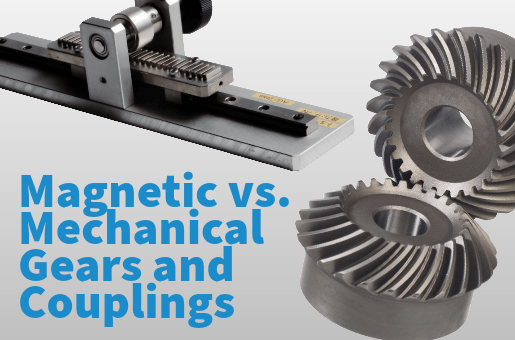
Magnetic vs. Mechanical Gears and Couplings
While mechanical gears and couplings have powered industry for many years, magnetic technologies are emerging as compelling solutions for applications where uptime, efficiency, contamination control and predictive maintenance are paramount.
Recently, engineering distributor R.A. Rodriguez (UK) Ltd expanded its portfolio to include KHK magnetic gears and couplings. The addition complements the company’s established range of mechanical power transmission components and provides design engineers with access to both traditional and magnetic solutions, enabling them to select the most appropriate technology for their application requirements.
As engineers explore alternatives to conventional power transmission, a key question emerges: when are mechanical gears and couplings the optimal solution because they deliver the best performance, rather than simply because they are the established choice? Equally, where do magnetic gears and couplings offer distinct advantages that justify a different approach?
Two Different Approaches to Torque Transfer
At their core, both mechanical and magnetic systems serve the same purpose: transferring rotational motion and torque between components.
Mechanical gears and couplings rely on physical contact between components. Gears transmit torque through meshing teeth, whilst couplings connect rotating shafts through rigid, flexible or elastomeric elements. This approach delivers reliable performance, particularly in industrial environments requiring high torque density and precise motion control.
On the other hand, magnetic gears and couplings transfer torque through magnetic fields rather than direct physical contact. Permanent magnets create attraction and repulsion forces, which are used to transmit torque without any physical contact occurring between the driving and driven forces.
Why Traditional Mechanical Systems Continue to Dominate
Mechanical gears and couplings remain the default choice for most industrial applications for several reasons. With decades of field experience behind them, engineers understand the performance characteristics and maintenance requirements of mechanical gears and couplings.
Additionally, many mechanical gear systems can transmit extremely high torques, making them a suitable choice for mining equipment, steel mills, marine propulsion, wind turbines and heavy manufacturing. For applications where predictable gear ratios and positioning accuracy are critical, such as robotics, machine tools and process automation, mechanical gears are a proven, reliable solution.
There are also cost considerations, as mechanical components remain less expensive to purchase and install than magnetic alternatives. That is not to say that these advantages do not come with trade-offs.

The Magnetic Advantage
Magnetic gears and couplings were developed to address many of the limitations of contact-based systems. As torque is transmitted magnetically and without physical contact, friction is not an issue and wear is dramatically reduced. Without contact, lubrication requirements are minimised or eliminated, fewer consumable parts require replacement, and maintenance intervals can be extended.
One of the most valuable features of magnetic gears and couplings is inherent overload protection. When torque exceeds the design limit, the magnetic field slips. As a result, the equipment is protected from shock loading, and mechanical damage can often be avoided.
Magnetic gears and couplings offer isolation and sealing benefits, as they can transmit torque through a physical barrier. This creates significant advantages in chemical processing, pharmaceutical manufacturing, food and beverage production and semiconductor fabrication.

The Strategic Decision
Despite growing interest in magnetic solutions, traditional technologies are far from obsolete. In large-scale industrial machinery, mechanical gears will likely remain dominant for years to come, due to the high torque density, lower procurement costs and precise positioning they offer.
However, magnetic gears and couplings are particularly attractive where reliability and cleanliness outweigh initial cost considerations. They eliminate leakage concerns in hazardous or corrosive environments, offering a strong advantage. Meanwhile, in pharmaceutical, semiconductor and cleanroom applications magnetic components help prevent particle generation and maintain process integrity.
As industries place greater emphasis on uptime, predictive maintenance and total cost of ownership (TCO), magnetic technologies are increasingly being evaluated by design engineers. The question is no longer whether magnetic systems can compete with mechanical solutions, but where they deliver the greatest long-term value.